養生 Yang Sheng – Nourishing Life
The term “Yang Sheng 養生 – Nourishing Life” is found primarily in Chinese medicine and Qi Gong. In the past, the term Dao Yin was also used for nourishing life.
Yang 養 = to nourish, to care for.
Sheng 生 = life, growth.
Dao Yin導引 = guiding (Qi) and stretching (the body).
Where and why
According to my observations and research, the “life-nourishing aspect” is also found in the traditional Chinese martial arts “Taijiquan and Xingyiquan”. Why is nourishing life generally hardly spoken of or mentioned in these circles?
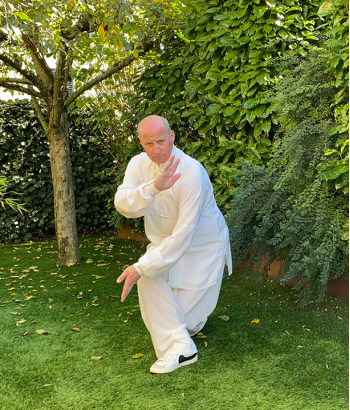
Xingyiquan
This has to do with the fact that nourishing life is a positive side effect of traditional Chinese martial arts. The focus here lies on the martial arts and the development of Gong Fu.
One must realize that at the time these martial arts were developed, people still had to defend their houses and villages themselves, or some earned their money as bodyguards for wealthy families.
My research into the traditional Taijiquan and Xingyiquan lineages that I follow has shown that the earlier masters generally reached a very old age and were able to maintain their martial arts and their health until the end of their lives. I see this as proof that these arts have a high life-nourishing aspect.
Body and Mind
Through training and engagement with one’s own body and mind, self-perception is greatly improved. For the aspect of nourishing life to unfold its effect, the external conditions, posture, and movement must be worked out again and again, and misunderstandings eliminated. I do not want to go into these principles in detail here. The principles must be explained directly and conveyed through feeling.
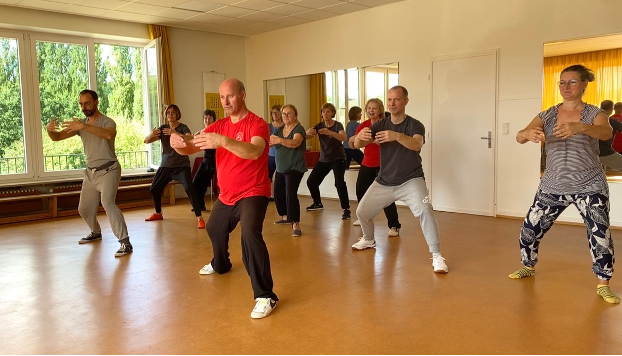
Yang Sheng – Nourishing Life “Exercises”
There are many Taijiquan players who have been practicing for many years but have not been introduced to the inner principles of these arts. Why this is so, I cannot and do not want to judge. Many Taijiquan practitioners think that they are practicing Taijiquan when they learn the movement sequences, but Taijiquan training only really begins once one has learned the form (movement sequence). For now, it is about studying the inner principles of these arts and anchoring them in the body.
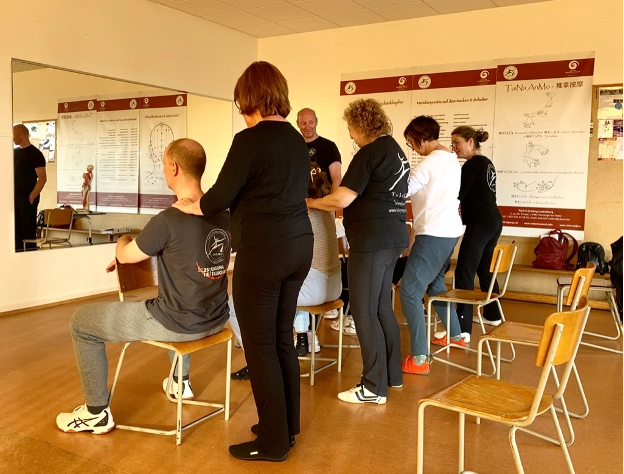
Yang Sheng – Nourishing Life “TuiNa AnMo”
Some principles are:
Fang Song Relaxation of the body and mental loosening of the mind
Yi Imagination, intent, intention
Kai He Opening and Closing
Jin Internal connections
Chansi Jin Spiral movements (force)
Ting Jin Listening to force
Dong Jin Understanding force
Hua Jin Neutralizing, transforming, dissolving force
Internal Movements
In the study of internal movements, while maintaining correct body alignment, the natural movements of the body will emerge more and more clearly and distinctly. Suppleness and relaxation arise as incorrect forces dissolve.
The body begins to regulate itself, whereby physical ailments improve or dissolve. The permeability of the meridians and the network vessels is stimulated, which improves energy flow and blood circulation as tissues and joints open. Through relaxation, stretching, and spiral movements, adhesions in the fascia are released, and the electrical impulses of the nerves can be transmitted freely. This leads to the alleviation or elimination of pain.
The relaxed mental concentration and attention also relaxes the mind and has a positive effect on the psyche. Through constant and intensive self-study and by observing students, great knowledge and a good understanding of physical movements and body manipulation are developed. For this reason, many martial arts masters were also good physiotherapists and TuiNa AnMo therapists, even if they had no medical training.
Polar Perspective
To understand these arts, we must discard the “dualistic view” in our worldview and practice the “polar view”. In the polar view, one generates the other and requires the counterpart to exist or arise at all. We use, among others, the principles of Yin and Yang and the Five Phases. Chinese philosophy thus also has a great influence on these arts.
Regardless of the reason for practicing Taijiquan or Xingyiquan, it is important to understand the inner principles. Only in this way can Yang Sheng – nourishing life fully unfold. It would be a pity not to use these arts to their full extent, because the time invested in training is the same, but health, inner strength, and nourishing life would benefit more from it. Of course, I have heard people say that we only practice the arts to nourish our lives, but if we do not practice the inner principles, we cannot speak of Taijiquan or Xingyiquan. We are then speaking of beautiful gymnastics, which is already very good.
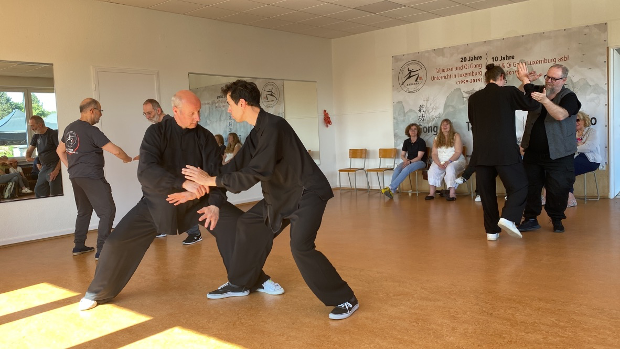
Tuishou in Taijiquan
Benefits that count
The fact that traditional martial arts have a positive influence on people is shown by the fact that they often adjust their work-life balance and change their lifestyle. I also repeatedly experience that many physical and psychological problems can be reduced or eliminated through the right training.
Most students do not come to Taijiquan to learn how to fight, but they realize after some time that they must understand the martial principles of these arts to discover their inner resources and for the cultivation of nourishing life to fully unfold its effect. The development of Gong Fu is at the forefront of the internal martial arts, and over time, students take more and more pleasure in testing their inner skills through Tuishou and developing themselves further thereby.
The beauty of these arts is that we do not work only with external, gross force, and so most students have no problem with partner exercises, especially since one preserves the inner space through Beng Jin. I hope I was able to make a small contribution to encouraging newcomers to deal with the arts in depth. I therefore wish all practitioners of the Chinese internal martial arts high Gong Fu and good “Nourishing Life”.
21.02.2025, V. Bänsch